How to Build a Great Startup Board of Directors (Hint: Your Board Is Not Your Boss)
A founder's guide to board member roles and responsibilities, how to choose board members, and how to turn your startup board into a high-trust team.

My First Board Meeting Was a Disaster
Having not slept much the night before, I was nervously nibbling on animal crackers provided by the co-working space in big Costco-style containers. As I waited for my lead investor to arrive, I gulped down my second cup of coffee.
It was my very first board meeting, and I had no idea what I was doing.
Although I had been running my startup for three years, I had never had a startup board of directors before. Even with an MBA under my belt, I did not really understand board member roles and responsibilities, or how any of it was supposed to work.
As the meeting started, I walked my one board member through the long deck I had meticulously prepared.
I spent the next two hours trying to convince her that I was doing a good job of running the company she had invested in only a couple of months earlier.
The meeting was one long, dull update followed by a few questions and some polite conversation.
A total waste of time.
It was not my investor's fault at all. It was mine.
I did not know what I was doing.
I had never even been to a board meeting before. My picture of a board was comprised mainly from movies I had seen as a kid where the board is portrayed as a group of twenty old white guys sitting around a wood table in a dimly lit room.
In hindsight, it is embarrassing.
When I hired my first CEO coach, one of the areas we explored in our early work was my relationship with my board.
He challenged me to begin to think of my board members as partners. He pushed me to risk bringing questions and emotions to the board instead of answers and stoic resolve.
As I began to risk openness with my board, the sense of aloneness that characterized much of my early years as CEO lifted.
We moved into real partnership.
By the time we sold the company in early 2019, our startup board of directors had changed dramatically. It was comprised of our lead investor, a prior head of product at a public company, an experienced CEO from a later-stage SaaS startup, and me.
Our board functioned as a high-trust, high-impact team built on trust, openness, intimacy, and clear expectations.
My board became a source of support, friendship, and tremendous intellectual brainpower around the company's most challenging problems.
If that kind of support and partnership from your board sounds like a pipe dream, read on.
If I can build high impact board, so can you.
Why Most CEOs Get the Board Relationship Wrong
Most CEOs I meet treat their board like their boss.
Yes, the board does hold the accountability of hiring (and at times firing) the CEO. That is true.
But holding that one accountability as the framing for the relationship results in a setup for disaster.
If you are a CEO, and you hire a head of product, for sure one of your accountabilities in that relationship is to continue to evaluate over time whether that person is the right fit for the job.
But that is not the heart of your work.
The heart of your work with that individual is to partner with her on the company's product strategy. To ensure she has the support, clarity, and resources necessary to thrive in her role.
What if you reframed the relationship entirely? What if the board's primary role is to help you flourish in the CEO role? What if their job is to help you shoulder the massive accountabilities of:
- Holding the company vision
- Recruiting and retaining the senior team
- Resourcing the team with capital and clarity
A good board support you and help you to excel at each of these accountabilities.
A great board will also go one step further and actually help you see around corners. When we were chewing on this post together, Bullpen Capital partner Duncan Davidson noted:
A great board will spot problems or issues ahead of the CEO. This is where broader perspective and experience can shine. Often the moment of great opportunity or risk is not recognized until it has passed.
A great board will help you improve in your role as CEO through support, trust, and partnership and help you lift your head up to see more of the game board. To get there, we need to turn this ragtag bunch into a high-function team.
Don't worry; you've got this. Let's begin.
Board Member Roles and Responsibilities: What Each Seat Should Do
Before we talk about how to build a great board, let's get clear on what a startup board of directors actually does. Most first-time founders have never seen a board operate up close. Here is a clear breakdown of board member roles and responsibilities:
Understanding board member roles and responsibilities is the first step. The second is making sure you have the right people filling those roles.
Start with What You Already Know About Great Teams
You probably already know a lot about high-function teams.
Think about the best experience of teamwork you have ever been a part of. It might be a sports team in high school, a debate team, or any other time you have had the feeling of:
"This is it! This is what happens when humans pull together and work really well together toward a common goal."
Now, write down the values or characteristics that team possessed. A few I hear often:
- Trust
- Intimacy and genuine knowing of one another
- Fun and shared purpose
- Clear roles and honest communication
- Willingness to have hard conversations directly
Now run this simple exercise:
- Score your pinnacle team on each value from 1 (absent) to 10 (exceptional). Average the scores.
- Score your current board on the same values. Average those scores.
- Compare the two. The gaps are your roadmap for improvement.
You might ask why you get to set the scorecard. Why should you get to decide what makes a great team? I would suggest two things:
- There are probably some universalities to the values you identified
- This is your company. You are the CEO. The board is yours to shape in the way that best serves you and the company. So if you are not going to set the standard for high-function, who will?
How to Choose Board Members: Getting the Right People on the Bus
In addition to inviting CEOs to shape their own scorecard for high-function, which I love to do early on in coaching work, I am a big fan of the idea presented in Good to Great of focusing first on getting the right people on this bus.
In Good to Great, Jim Collins analyzes companies that outperformed competitors in their space:
Collins and his research team identified a set of elite companies that made the leap to great results and sustained those results for at least fifteen years. How great? After the leap, the good-to-great companies generated cumulative stock returns that beat the general stock market by an average of seven times in fifteen years, better than twice the results delivered by a composite index of the world's greatest companies, including Coca-Cola, Intel, General Electric, and Merck.
In the study, Jim's team noted that great leaders begin with the following straightforward effort:
- Get the right people on the bus.
- Get the wrong people off the bus.
I often hear CEOs talk about gaps in their leadership team, but I rarely hear them speak about gaps in their board.
That is problematic.
Ask yourself: who is on your board today, and why? For most startups, the answer is 1-2 founders (because they founded it) and 1-2 investors (because they wrote a check). That is not a recipe for a high-impact startup board of directors. That is a default, not a design.
How would you design your board if you were designing it from scratch based on what you uncovered above about what you know about a high-function team?
Here is a framework for how to choose board members based on the expertise gaps your company actually has:
As you consider your dream board, ask yourself:
Who needs to get on the bus?
Who needs to get off the bus?
None of this is easy. Recruiting board members and aligning the board on new additions takes work. Managing toxic board members out of the role is even harder. But it can be done.
It starts with holding a clear vision for the board you are trying to develop. If you start there, you will be ahead of the pack.
Moving Toward a High-Function Startup Board: Signs to Watch For
Once you are at least on your way toward having the right people one the bus, it is time to start plotting how to make this team a team.
Reflect back on what you identified above as the key characteristics of a high-functioning team.
If you need an additional model, I am a big fan of The Five Dysfunctions of a Team paradigm designed by Patrick Lencioni.
Here is how to diagnose where your board falls on the spectrum:
Patrick presents the following pyramid to help us understand where teams fall short on the road to high-function.
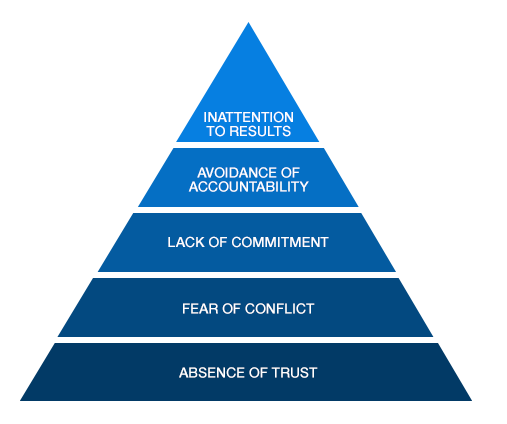
How would you show up differently as a CEO if you had a high-trust, high-function board behind you?
Let's explore how to get there.
Practical Tools for Building a High-Function Startup Board
Start with Shared Values
Once you have the right people on your board, or are working toward that end, it is time to begin moving toward trust and function.
You may begin by running through the exercise above with the board. Ask the board to share briefly about the best team they have experienced, surfacing together shared values identified across those experiences, and then scoring this board on those values.
This brief exercise can be a powerful way to align the board on the work at hand.
Each board member will benefit from remembering the experience he or she had on a great team. That memory has a way of igniting excitement around what's possible when humans come together effectively.
You might refine the list of values to an agreed upon list of values for this particular team, this particular board.
Finally, score the board on those values at present and discuss how you might improve as a team.
Set Clear Board Member Accountabilities
A second foundational element of a high-function startup board of directors lies in clear accountabilities. I am amazed how often CEOs I speak with have no idea what the actual job of a board member is.
They might have even recruited people to their board, aside from investors, without providing any clear expectations on what the board member is actually signing up for.
That makes about the same amount of sense as hiring a head of product without giving her any details at all on what you are hoping the company's product might achieve.
I have written elsewhere about the three accountabilities of a CEO. One of those accountabilities is resourcing the team with clarity [and capital]. That team includes the board.
It should be explicit what is expected of a board member:
- What is expected of a board member in a meeting, before a meeting, and between meetings?
- How is the board member expected to support the company and the CEO?
- How will board member know whether she is succeeding or failing in her role?
- How will board member performance be reviewed and discussed?
High function requires clarity.
How to Build Trust on Your Startup Board
Once you have the right people on the bus and the foundational elements in place for clarity, it can be helpful to invest in trust building.
Trust begins with intimacy.
If you have gone through the exercise above to reflect on your own experience of being part of a great team, you will likely find that the relationships on that team were strong. People knew one another well, had worked or played together over a long period of time, and knew based on that experience that they could deeply rely on one another.
Here are a few practical ways to build trust on your board:
Use Check-Ins to Start Every Board Meeting
In most meetings, and board meetings are no different, we often jump right into the work.
What you might try instead is starting with a check-in.
A check in can take the form of a question or a color.
A question-based check in might be:
- What has been the biggest change in your life since our last board meeting?
- What are you most longing for in your life right now?
- What curiosities are you present to coming into today's meeting?
Some of this may sound wonky if you have never talked as humans in the board room. But if you develop the practice of connecting in your humanity before digging in on the work the dividends can be big.
Another option is a color check in. At my last company, we practiced color check ins at the beginning of every meeting.
You go around the circle, and each person simply checks in as either green, yellow, or red:
- Green: I'm here, present, good to go
- Yellow: I'm here but some worry or concern outside the room is holding my attention
- Red: I'm physically here but very distracted by something big going on outside the room
People are welcome to share details on anything that has them yellow or red (or green for that matter) but it is not required.
For people who are yellow or red, you might ask if they need any support from the team. Often simply sharing that you are yellow, or giving voice to a concern or anxiety that has your attention, is enough to help you set the anxiety aside and bring your attention fully into the room.
The goals here are to:
- Acknowledge we are all human and that we bring that humanity into meetings
- Give us an opportunity to know more about what is going on for each of us and to support one another in what is present
- Help each team member transition from outside the room to inside the room
The result is greater intimacy, a tighter team, and more focus in the room.
Set and Follow Up on Board Commitments
Another tool for building trust is the setting and following up on commitments.
Put simply, we trust people who say what they are going to do and then do what they say they are going to do.
Here is how to build this practice:
- At the end of each major discussion topic, identify next steps with clear owners (the CEO should not be the only one leaving with tasks)
- Maintain a shared place for action items, somewhere less formal than board minutes (a follow-up email, shared doc, or Trello board)
- Follow up on outstanding items via email, check-in calls, or at the next meeting
Building a cadence where tasks are clearly assigned and where board members follow-through on their commitments will help build trust.
Share Bad News Immediately
There is common advice around board management that goes something like:
Never share bad news in the board room.
I think that is solid advice. But we might refine it a bit further to be:
Share bad news quickly and openly.
As CEO, I made a practice of calling board members within 24 hours of receiving difficult news. In the early years, I thought I needed the facts and plan fully sorted before sharing. But that approach was problematic:
- It delayed my ability to share the news
- It prevented me from asking for support from my board members, a.k.a. my teammates
- It left me feeling alone on the hardest days
Sharing bad news quickly invited discussion, support, and teamwork. And it built trust.
Orient on Results: Measure the Board, Not Just the Company
Most boards focus on the performance of the company but forget the performance of the board.
Well run companies begin with great leadership. And for companies with boards, great leadership should begin at the board level.
Here is how to hold your board accountable to its own growth:
- Set clear 1-year targets for how you want to function as a team
- Agree on clear goals with measurable ways of tracking progress
- Check in quarterly on progress against those goals
- Discuss openly what has improved, where you are blocked, and what you have learned
- Celebrate wins
- Consider 360 reviews of board members, facilitated by outside support to avoid awkwardness
Key Takeaways: Building a Great Startup Board of Directors
- Your board is not your boss. It is a team you lead. Reframe the relationship from reporting to partnership.
- Understand board member roles and responsibilities. Every seat should have a clear purpose, not just be a default from fundraising.
- Design your board, do not default into it. Ask: who needs to get on the bus? Who needs to get off?
- Use a team framework. Score your board against your own model of what makes a great team. The gaps are your roadmap.
- Invest in trust. Check-ins, commitments, and sharing bad news early are the building blocks of a high-function board.
- Measure the board, not just the company. Set goals for how the board itself functions and review progress quarterly.
There Is No Perfect Board
Like most things in startups, there is no perfect here. Boards, like all teams, are comprised of humans. We change continually at the individual level, so as teams are are fluid.
You might let go of perfect.
The goal here is improvement and the North Star is support.
The company deserves support. You deserve support.
This will not happen overnight. But you have what it takes to create and lead the board you desire.
If I can be helpful along the journey, please drop me a note.
-Matt
Frequently Asked Questions
What are the core roles and responsibilities of a startup board member?
At a minimum, board members are responsible for governance oversight, strategic guidance, fiduciary duty to shareholders, and supporting the CEO. In practice, the best board members also serve as active mentors, open doors to key hires and partnerships, and help the CEO see around corners by bringing pattern recognition from their own experience. Clear expectations should be set from day one.
How many board members should a startup have?
Most early-stage startups operate with 3-5 board members: 1-2 founders, 1-2 investors, and 1 independent member. At Series A, a 3-person board (2 founders + 1 investor) is common. By Series B, expanding to 5 seats with at least one independent director is standard. The goal is to keep the board small enough to function as a real team while covering the key expertise areas your company needs.
How do I remove a board member who is not contributing?
Start with a direct conversation. Share your expectations, point to the gap, and give the member a chance to step up. If nothing changes, work with your legal counsel to understand the governance path for removal. Independent members are easier to transition than investor board seats, which are typically tied to investment agreements. Managing toxic or absent board members out is hard, but it is part of the CEO's job.
What should a startup board meeting agenda include?
A great startup board meeting agenda includes: a check-in (human connection before business), a brief CEO update on key metrics and narrative, 2-3 strategic discussion topics where the board's input adds real value, a review of prior commitments, and clear next steps with owners. Avoid spending the entire meeting on updates. The most valuable board meetings are the ones where the CEO brings the hardest questions, not the prettiest slides.
Frequently Asked Questions About Startup Boards and Board Management
Common questions founders ask about building, managing, and getting real value from a startup board of directors.
What are the core roles and responsibilities of a startup board member?
At a minimum, board members are responsible for governance oversight, strategic guidance, fiduciary duty to shareholders, and supporting the CEO. In practice, the best board members also serve as active mentors, open doors to key hires and partnerships, and help the CEO see around corners by bringing pattern recognition from their own experience. Clear expectations should be set from day one.
How many board members should a startup have?
Most early-stage startups operate with 3-5 board members: 1-2 founders, 1-2 investors, and 1 independent member. At Series A, a 3-person board (2 founders + 1 investor) is common. By Series B, expanding to 5 seats with at least one independent director is standard. The goal is to keep the board small enough to function as a real team while covering the key expertise areas your company needs.
How do I remove a board member who is not contributing?
Start with a direct conversation. Share your expectations, point to the gap, and give the member a chance to step up. If nothing changes, work with your legal counsel to understand the governance path for removal. Independent members are easier to transition than investor board seats, which are typically tied to investment agreements. Managing toxic or absent board members out is hard, but it is part of the CEO's job.
What should a startup board meeting agenda include?
A great startup board meeting agenda includes: a check-in (human connection before business), a brief CEO update on key metrics and narrative, 2-3 strategic discussion topics where the board's input adds real value, a review of prior commitments, and clear next steps with owners. Avoid spending the entire meeting on updates. The most valuable board meetings are the ones where the CEO brings the hardest questions, not the prettiest slides.

Sanity Notes Newsletter
Join the newsletter to receive semi-weekly updates in your inbox.



)