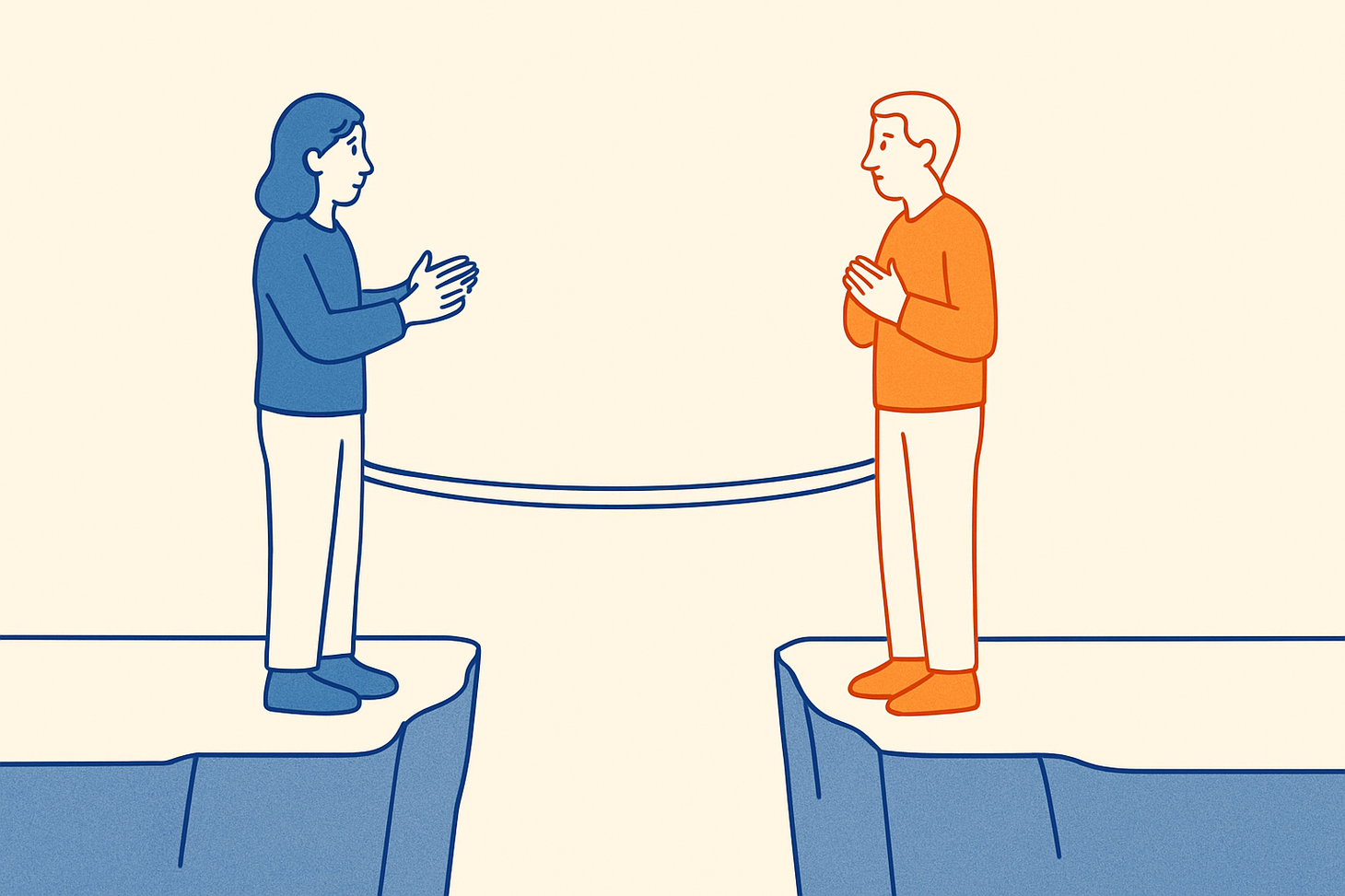
Founder Relationship Problems: The Unspoken Pain of Co-founder Relationships
Cofounder relationships are at the heart of most startup stories. But like most marriages, there’s as much pain and struggle as joy and collaboration. Often more. Why is no one talking about this?
Founder relationship problems are among the most common, and most painful, reasons startups fail. If you're a CEO or cofounder sensing cracks in your partnership, you're not alone. In this post, I'll share the early warning signs of cofounder conflict, the predictable forces that cause relationships to break, and a practical repair plan you can start today.
This guide is for CEO and cofounder teams at any stage. Whether you're exploring working together, navigating your first fundraise, or trying to save a relationship that's already strained.
One freezing, rainy day in Paris
I remember walking around Paris in the freezing rain, March of 2010, shivering as I chatted into my earpods about the California dream.Todd and I had been talking for months about starting something again. Our first attempt at working together had been wildly fun but short-lived. We had started a car-comparison website out of my apartment in Ann Arbor, MI, when we were both 23 years old.
The plan had been to move to Seattle and build the business there, but Todd fell in love with a beautiful girl named Katie and decided a move out of Michigan wasn't in the cards for him.
Six years after we'd first started something together, I was trying to convince Todd to make the big move to California. He and Katie decided to make the move.
We didn't have much of a vision for what we might be building. It didn't much matter to us. The dream wasn't to build the next Facebook. The vision was to live by the ocean and work with our friends.
We optimized for friendship, not for pressure. That choice would come back to haunt us.
We convinced one of my other best friends, Steve, to join us. Steve was one of the few software engineers I knew, also brilliant, and he agreed to join our haphazard journey into the what's next.
Kevin would join as our fourth cofounder after we sold our first barely-off-the-ground venture and evolved our second project into what would eventually become Twenty20. Kevin would become known as 'the Zenmaster' for his unflappable nature and never-ceasing smile. But in the earliest beginning, it was just the three of us: Todd, Steve, and me.

Seven years later, I would find myself the only remaining member of those original three still at Twenty20. As we went through the sale of the business last year, this realization was poignant and painful to me.
We had far exceeded our expectations on nearly all fronts. We had built a product used by hundreds of thousands of people around the world. We had worked with some of the best investors in the world. Eventually, we built a very unique culture and a beacon on the westside of Los Angeles for the idea that the workplace can be a source of humanity and personal growth.
But on our original mission to live by the beach and work with our best friends, we failed.
The early signs of co-founder relationship problems
Looking back, the warning signs appeared in our first year together. If you recognize any of these in your own cofounder relationship, pay attention. They tend to compound over time:
| Warning Sign | What It Looks Like | Why It Matters |
|---|---|---|
| Role confusion | No one is sure who owns decisions | Duplicated effort, dropped balls, friction |
| CEO isolation | CEO carries anxiety alone | Resentment builds, cofounders feel excluded |
| Silence after conflict | Disagreements never get resolved | Avoidance normalizes, trust erodes |
| Loss of playfulness | Joy gives way to obligation | Relationship feels like a chore |
| Work-only relationship | No time together outside the office | Friendship becomes transactional |
| Information asymmetry | One cofounder knows far more | Power imbalance, paranoia grows |
| Unspoken resentment | Privately feeling you do more | Passive aggression, withdrawal |
| Avoidance of loaded topics | Equity/performance off-limits | Landmines accumulate |
| Recurring tension | Same issues surface repeatedly | Exhaustion, hopelessness about change |
| Role-first identity | See cofounder as 'the CTO' first | Dehumanization of the partnership |
Why these signs appear early: None of us had ever seen it done right. We had never worked in a successful startup nor seen a company thoughtfully run from the ground up. Somewhere in my first 30 years of life, I had arrived at a picture of leadership that implied leaders figure things out alone. This alone-ness was a cave of my own making. And it contributed significantly to the cracks in our foundation.
Why cofounder relationships break (the predictable forces)
If I felt apart from my cofounders in the early days, that separation was exacerbated greatly when we decided to raise venture capital. Understanding why cofounder relationships break can help you anticipate and prevent these fractures:
- Fundraising shifts attention outside: Your focus moves from building together to pitching investors, managing boards, and external stakeholders. The internal relationship gets neglected.
- Power and role hardening: Early fluidity gives way to formal titles and hierarchies. The CEO becomes 'the boss' rather than an equal partner.
- Pressure and speed: With outside money comes accountability and urgency. There's less time for the conversations that maintain connection.
- Information asymmetry deepens: The CEO attends board meetings, knows the runway, fields investor concerns. Other cofounders feel increasingly in the dark.
- Identity and ego: Success (or failure) becomes tied to personal worth. Conversations about performance feel like attacks on identity.
- Lack of a conflict container: Without a dedicated space to process tensions (a coach, therapist, or structured check-in), issues accumulate until they explode.
In the first year, when it was just the three of us, we really felt like a team. Even if I found myself often in my own head or isolating in my anxieties, we sat in the same small room together and talked about so much of the work together. Although there’s much I wish I could go back and do differently, there was some real magic in those early days.
Within two years, Steve would be out of the company entirely and Todd and I would be barely speaking. When I moved back from Paris, all I wanted was to have a little business by the beach where I could go to work with my best friends every day.
Practical guardrail: Establish a weekly cofounder relationship check-in. Not a status update, but a dedicated space to ask: 'How are we doing as partners? What's unsaid between us?'
Case study: when role-fit and power collide (Steve)
Steve and I met as the 2nd and 3rd employees of a startup in Los Angeles in 2005. We were both new to town and did not have many friends. We sat side by side in an office smaller than my college dorm room. And we became great friends.
Steve is a brilliant, MIT-trained engineer who we often joked, for good reason, could build anything in two weeks.
When Todd and I started talking about chasing the dream, we decided we needed a technical cofounder. And Steve was the obvious choice.
We took a road trip, rented a cabin, and played a hundred games of Catan. By the end of the weekend, we'd decided to start a company together.
Two years in, we finally hit traction with Instacanvas, grew virally, and raised our first real venture capital.

With the money came a mandate to grow the team and explore predictable ways to scale revenue outside of our early viral engine. We began hiring engineers.
For me, as a non-technical CEO running my first venture-backed startup, the world of engineering was quite a black box. Over the years, with the patient partnership of Michael Robinette, who would come in later to lead engineering for us, I slowly learned how to help build a culture where engineers could thrive. But, in 2012, I had no fucking idea, and I floundered.
Todd, Kevin, and I entrusted the green lighting of engineering hiring, and all engineering management, to Steve.
It started out pretty well. Except for the first engineer we hired quitting without notice, seemingly leaving the country and taking our laptop with him. You cannot make this shit up.
But after a couple of months of growing the engineering team, we started to hear complaints about Steve. We were told in no uncertain terms that Steve had to go or our best engineers would quit.
To my recollection, it was Steve’s first time managing, and I deeply regret not partnering with him more closely to help resource him in that effort.
Pattern callout #1: Role mismatch ≠ betrayal. Steve was probably wonderfully suited to being an individual contributor or architect but not well suited to scale an early engineering team. That should have been totally fine.
Pattern callout #2: First-time management without support. I didn't know how to assist, and Steve didn't have the coaching or resources to succeed in a role he'd never done before.
Todd and I took Steve to lunch and fumbled our way through asking him to consider shifting his role and supporting our desire to bring on a more experienced engineering lead. I have a pit in my stomach even now remembering that lunch. For better or worse, we paired our ask with a request he return a portion of his equity to help us cover the substantial grant we would need to make to recruit a top lead.
Pattern callout #3: Equity asks under stress trigger shame and defensiveness. Never tie equity changes to performance conversations.
None of this landed well with Steve, and he promptly quit.
While I believe still we did the necessary thing for the company by making a hard change, I was heartbroken over the loss of Steve’s partnership and friendship. 7 years later, I still carry grief over that loss.
Our friendship has not recovered. And I lost one of my very best friends.
I know Steve experienced his own difficult losses around his departure. And that grieves me as well.
Steve was gracious in the end as is his lovely character. We met for a beer a year or so after he left. We chatted about our friendship from the earliest days in that tiny office in Manhattan Beach to the difficult parting and the roads our lives had taken since. I hope there are more beers like that to come.
What I'd do now:
- Get Steve coaching support before promoting him to management
- Create clear IC vs. manager career tracks from the start
- Set explicit expectations for the management role and check in weekly
- If role change was needed, offer a staged transition with dignity. Not a surprise lunch conversation tied to equity
Case study: when friendship becomes 'work only' (Todd)
Todd and I had been best friends from the time we met in 2003 until we decided to move to LA together in 2011. After shutting down our first company in 2004, both of us pined for another opportunity to work together.
Those first days of starting something together were glorious. Our first taste of carving our own destinies.
I was thus thrilled when we settled in LA together with a commitment to finally starting another business together.
We walked around Hermosa Beach brainstorming ideas. Everything from a lux movie theater to a car wash made the list.
Even in those early days, the work never held the playfulness and levity we had treasured from our first stab at working together 7-years prior.
I think, at 24, work still felt very much like it could be play. We had little to lose. We had little savings, cheap apartments, and we were both single.
Then at 31, we were both married. We both completed top MBA’s and had spent years building separate careers.
Key lessons from our journey:
- Ambition drift: Our ambitions and values had evolved independently in ways we never stopped to discuss.
- Fear → isolation: I turned my anxiety inward. I did not let Todd into the fear I was facing.
- Role-first identity: I found myself seeing Todd first as our VP of Product rather than as my best friend.
- 'No work talk' doesn't equal intimacy: We made stabs at dinners with 'no work talk,' but it was never quite the same as friendship pre-startup.
- Coaching creates language: We attended a cofounder bootcamp and both began working with coaches who helped us process our experiences and gave us common language.
I personally began to understand that I had major issues with trust that went all the way back to my childhood. I learned from my family of origin that it was not always safe to let other people into my fear. I internalized a message that it was dangerous to take up space even among trusted loved ones.
This played out in my role as a founder and CEO. As the stakes increased, so did my fear and anxiety. And I turned that anxiety inward.
Todd would ultimately choose to leave the company during the large layoff. That layoff and company reset would mark a turning point in the trajectory of the company. From that point forward the team would stick together, 5x revenue, and eventually sell the business.
As we plotted the layoff that would cut our team from 55 to 12, I asked the leadership team to assess their own determination to stay for at least the next year. The day after I asked, Todd asked me to breakfast and told me the time had come for him to leave. His heart was in scaling the team. He knew if he stayed it would mean less people work and more product work. His heart just was not in that work anymore.
I credit Todd with having the courage to evaluate what was right for him and for his family. A few days later, he had second thoughts. He shared with me that he was struggling with whether leaving meant abandoning the team and abandoning me. To this day, that loyalty and care fill my chest with gratitude for Todd.
We ultimately decided it was the right time for Todd to leave. And I am so glad we did. Not because of any impact it did or did not have on the company. But rather because his leaving marked the beginning of our rediscovery of our friendship.
What we got right (protective factors)
There many things about the way we were and the way we began our work together, that I celebrate and would never change. Among those:
1. Choosing people we trusted. It was never a question that we trusted one another. For all the things that went right and wrong, we never argued about ethics or truthfulness. We always believed that whatever one another was saying was absolutely true.
Why it matters: Trust is the foundation. Without it, every disagreement becomes a threat.
2. Approaching the adventure with playfulness. I smile when I think back on those early Michigan trips where we drank beer, played cards, and dreamed together about what our future might hold. We were in it for the fun of it. To live near the beach and work with our friends. We did not do a great job holding to it, but I sure am glad we started there. What a beautiful beginning for a human-centric company.
Why it matters: Playfulness creates resilience. When pressure hits, you need memories of joy to draw on.
3. Sharing a value of friendship > money. We argued about plenty of things, but with the confined exception of equity handling around Steve’s departure, we never argued about money. For a company started among friends that far exceeded our expectations, that’s damn impressive. I credit this to the shared alignment of values of friendship over money and also a shared rootedness in honesty and ethical behavior.
Why it matters: Money disputes destroy more partnerships than any other issue. Shared values here are protective.
4. Establishing clearly-defined roles. We also never argued about who would own what. We talked it through, held the roles loosely, and got to work. We held a high degree of trust that when one of us said something was handled, it was handled.
Why it matters: Clarity prevents the energy drain of repeated negotiation and stepping on toes.
5. Turning to forgiveness when things get hard. Even looking back, I am pleased with the conversations that have followed our respective decisions to stop working together. From all sides, there has been a commitment to forgiveness and reconciliation.
Why it matters: Startups guarantee conflict. The ability to repair and forgive determines whether relationships survive.
If you already have these protective factors, protect them intentionally.
What we got wrong (where resentment grows)
There are also things I wish we could go back and do-over. Here are five:
1. Thoughtfully maintaining a friendship apart from work. Much like the importance of date nights for parents with kids, cofounders need to find a way to nurture their relationship apart from the company. I wish we had done better here.
Do this instead: Schedule monthly non-work activities. Camping trips, dinners with a 'no shop talk' rule, shared hobbies.
2. Aligning early on values. I do not recall us spending time talking about why we actually wanted to start a company. We failed to agree on what we would sacrifice to make the company work and what we would refuse to sacrifice.
Do this instead: Before you start, explicitly discuss your cofounder questions. Values, sacrifices, deal-breakers. Revisit annually.
3. Aligning early on 'what success looks like.' Our levels of ambition were not aligned. If you do not share the same North Star, it is easy to end up with misaligned incentives as the business grows.
Do this instead: Create a shared 'success scoreboard.' Financial, cultural, personal. Check alignment quarterly.
4. Creating a safe space for addressing hard conversations. My wife and I see a wonderful couple's therapist. Not because we have problems, but so we have a dedicated space to explore difficult topics. I wish we had established a similar space as cofounders.
Do this instead: Establish a monthly 'conflict container.' A standing meeting (or coaching session) dedicated solely to relationship health.
5. Discussing parallel paths for management vs. individual contributor (IC) roles. Management is not for everyone, and the ability to manage should not be the barometer for evaluating a founder. I wish we had done better here.
Do this instead: Define IC vs. manager tracks early. Ensure both paths carry equal dignity and clear expectations. See: not in the right role
Repair and closure (what reconciliation can look like)
As I close out this post, I want to express my deep love and gratitude to Steve and Todd.
Thank you for taking the risk to begin the journey with me.
It was one of my life’s great honors to cofound a company with you.
You invited me to the CEO chair when I had very little idea what that role entailed let alone how to do it well. And you suffered through some of my worst mistakes in leadership. The leader I eventually became was informed greatly by your honest early feedback and by your friendship.
I am sorry for the many mistakes I made as your CEO and partner. I think part of my work as a coach now is a desire to make amends for those early errors. I know they caused you pain, and I am very deeply sorry.
I love you both.
A closure template you can use:
- What I regret: Name your specific mistakes without deflection.
- What I appreciate: Acknowledge what your cofounder contributed.
- What I learned: Share how the experience changed you.
- What I wish for you: Express genuine goodwill for their future.
Remember: your cofounder's experience may differ from yours. Reconciliation doesn't require agreement on the past. Only willingness to honor both perspectives.
What to do if you see the signs (a repair plan)
If you recognize the warning signs in your own cofounder relationship, here's a step-by-step repair plan:
Step 1: Name it. Acknowledge to yourself that something is off. Denial delays repair and compounds damage.
Step 2: Request a dedicated conversation. Not in a status meeting. Not in Slack. Ask for 90 minutes, offsite, with no agenda except the relationship.
Step 3: Lead with vulnerability. Start with your own experience: 'I've noticed I'm feeling disconnected from us. I'm worried about our partnership.' Avoid blame.
Step 4: Listen without defending. Your cofounder's experience may surprise you. Resist the urge to correct or explain. Just receive.
Step 5: Agree on one ritual. Weekly cofounder check-ins. Monthly dinners without work talk. A shared coach. Pick one and commit.
When to get outside help:
• You've tried to talk but keep hitting the same wall
• Trust has broken down and you're questioning motives
• You're making decisions solo rather than together
• You're considering asking your cofounder to leave
If any of these apply, bring in a coach or mediator before the relationship is beyond repair. See: resolve cofounder conflict
CEO and cofounder: two roles, two responsibilities
One of the hidden tensions in cofounder relationships is the duality of being both CEO and cofounder. Or being a cofounder working with a CEO.
As cofounders, you're peers. You share risk, equity, and the emotional weight of building something from nothing. You owe each other honesty, care, and respect.
As CEO, one of you holds decision rights, board accountability, and often the final word. The CEO may need to make hard calls. Sometimes about other cofounders' roles, performance, or even continued involvement.
This creates tension: in the boardroom, the CEO is accountable. In the relationship, you're still equals who owe each other vulnerability and friendship.
A rule of thumb: Separate the role from the relationship. When making business decisions, wear your CEO/CTO/VP hat clearly. When nurturing the partnership, set the titles aside and show up as humans who chose each other.
If you're navigating a situation where a cofounder may not be in the right role, lead first with care for the person, then address the business need. The sequence matters.
For those of you reading this who are at the beginning stages of your own cofounder journey, or perhaps trying to diagnose cofounder challenges mid-way through the journey, you have great opportunity at hand.
You can build the fundamentals now.
You can explore the difficult questions early when your roles and the organization are malleable and change is easier.
If Sanity Labs can help, please reach out.
Todd and I are also workshopping a cofounder coaching workshop. If you would like to experience coaching designed by cofounders for cofounders, we would love to meet you.
Wherever you are in your own journey today, wishing you peace and ease.
-Matt
FAQ: Cofounder Relationship Problems
What are the early signs of cofounder relationship problems?
Watch for role confusion, the CEO feeling increasingly alone, silence after conflict, loss of playfulness, work-only relationship, growing information asymmetry, unspoken resentment, and avoidance of loaded topics like equity or performance.
Is cofounder conflict normal?
Yes. Cofounder conflict is predictable, especially after fundraising when pressure accelerates and roles harden. The issue isn't conflict itself. It's whether you have a safe container to address it before resentment builds.
What's the difference between CEO and cofounder?
As cofounders, you're peers sharing risk and equity. As CEO, you hold decision rights and board accountability. The duality creates tension: the CEO makes hard calls (sometimes about other cofounders), but in the relationship, you're still equals who owe each other honesty and care.
When should we hire a cofounder coach or mediator?
Get help before crisis. If you're avoiding each other, if trust has broken down, if you're making solo decisions, or if you're considering asking your cofounder to leave, that's the time. Don't wait until repair is impossible.
How do we talk about equity without destroying trust?
Never tie equity changes to performance conversations. If role fit changes, separate the discussion: first, agree on the new role and support needed; later, if equity must be revisited, bring in a mediator and frame it as company evolution, not personal failure.
Can cofounder relationships be repaired after a rupture?
Yes. Todd and I barely spoke for a period. But his leaving the company marked the beginning of repairing our friendship. Reconciliation requires both people willing to be vulnerable, name regrets, and rebuild trust outside the pressure of the company.
Where can I learn more about resolving cofounder conflict?
I've written extensively about this topic. Start with my posts on hard conversations, painful conclusions, and the 10 questions every cofounder team should discuss.

Sanity Notes Newsletter
Join the newsletter to receive semi-weekly updates in your inbox.