Distraction is Killing Your Business (and Stealing Your Joy)
Startup founders obsess over growth hacks, fundraising strategy, and product iteration. But when it comes to how to stay focused at work, most leaders miss the simplest and highest-leverage move available to them. Here is what I see in nearly every startup I work with, and what to do about it.
I spend a lot of time with startup CEO’s, founders, and executives. As a coach, I am routinely inspired by the energy, vision, and no-quit attitude that I observe. But there is one mistake that I see in nearly every leader I meet.
Why Focus Is a Startup's Greatest Competitive Advantage
An early stage company’s primary currency is focus. A startup is at a disadvantage against a large incumbent on nearly every measurable variable. Resources, depth of leadership, industry experience, marketing might, the incumbent wins every time. What a well-run startup has that a big corporation lacks is the opportunity to relentlessly focus on what really matters.
A startup can avoid bureaucracy, politics, legacy tech debt, bloated middle management, and other problems that plague incumbents. A startup can, should a startup choose, focus relentlessly on what matters.
So why are so many entrepreneurs trading away focus?
Signs You Are Struggling to Stay Focused at Work
Personal Focus: Warning Signs
- You are not setting clear, measurable, personal goals for each quarter and each week
- You are not blocking chunks of undistracted focus time throughout your workday
- You receive more than one audible/distracting phone alert per hour
- Your laptop alerts you of every incoming Slack message, text message, and email
- You check your email more than 3 times per day, often even when no new messages are present
Team Focus: Warning Signs
Check your team against these signals:
- A team member picked at random cannot name the 3 top priorities for the company this quarter
- A team member picked at random cannot point to a list of accountabilities within the company (ie who owns what to keep the ship afloat)
- An average team member is attending more than 2 to 3 hours per day of meetings
- No clear workplace communication guidelines exist for when to use Slack, email, or Zoom, or what the expected response time is, which results in an always-on mentality
- Your employees look fatigued and burned out not rested and energized
How to Stay Focused at Work: Personal Habits
These five habits will eliminate the most common sources of personal distraction:
- Meditate. Daily. Even 10-minutes of focused meditation per day can help retrain your brain to focus on the present.
- Block your calendar. Aim for at least 3 hours per day of focused work time. Stay out of meeting purgatory.
- Turn off your alerts. On your phone, on your tablet, on your laptop. All of them.
- Check email 1 to 3 times per day, no more. The more email you send, the more you receive.
- Clear your desktop. Hide your dock. Hide your menu bar. A clean screen is a calmer brain. What does your desktop look like right now?
If you want to go deeper on how personal habits like these connect to your energy and effectiveness as a leader, it is worth reading about building a morning routine that actually works.
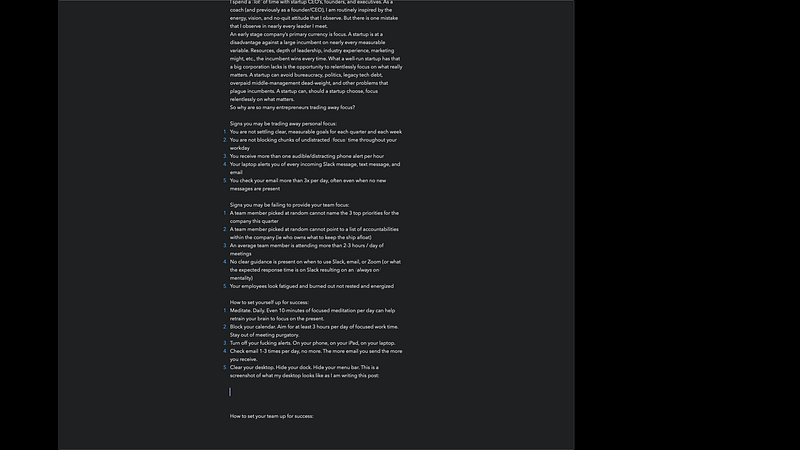
What does your desktop look like as you are reading this post?
How to Set Your Team Up for Focus
Individual focus is not enough if your team environment is designed for distraction. Here are the five changes that matter most:
- Set clear goals. I recommend a quarterly OKR practice where the team (or senior team) works together to examine the key risks of the business and recent learnings then sets 2–3 key objectives for the next quarter. Each objective should have a measurable success criteria, clear owners, and defined resources.
- Set a regular cadence for written updates. Get out of random check-ins and updates. Whoever is owning a given objective should provide a written update on a regular (ie weekly) basis. This should be part of a full-team or full-company update doc so that everyone knows when updates happen. Updates should be written so that the team doing the work has to collect their thoughts and present them in an organized fashion. Questions should be asked only after everyone has done the reading. Bonus points for asking the questions right on the Google doc.
- Establish clear workplace communication guidelines. See the table below for a simple framework.
- Set clear meeting guidance. Meetings should be short, carry an agenda, have an owner, have notes shared by one notetaker, and end when the agenda is complete. No meeting should exceed 50 minutes. Most should be 5 to 15 minutes and done standing up. Meetings must start and end on time.
- If you work in an office, make the office a quiet work zone. Conversations are great on walks, in the kitchen, or in a meeting, but work areas are for quiet, focused work.
Workplace Communication Guidelines: Slack, Email, and Meetings
One of the clearest things a leader can do to reduce team distraction is define when each communication channel should be used. Here is a simple framework:
Train your team to turn off notifications. Real-time responses are not expected and should not be rewarded.
Let Your Teammates Work
For most of us, a sense of deep joy and accomplishment is possible when we experience flow, or focused work, and when we leave the workday with a sense of accomplishment. We love to let our creative or analytical juices flow.
When we allow interruptions to rule the day, or when we fail to slow down and set clear goals, we rob ourselves and our teams of focus.
Our projects grind along, our companies fail, and we burn out.
Slow down today to help your self and your team move toward focus. Your mind and your team will thank you.
And if the distraction you are fighting is more internal than environmental, it may be worth exploring how founder burnout and chronic overwhelm connect to difficulty staying focused.
Wishing you peace on your journey today.
-Matt
If you are a founder or CEO navigating focus, clarity, and leadership challenges, CEO coaching might be worth exploring.
Frequently Asked Questions
How to stay focused at work when there are constant distractions?
The most effective approach is to remove the source of distraction rather than trying to resist it through willpower. Turn off all non-essential alerts on every device. Block at least 3 hours of uninterrupted focused work time on your calendar each day. Check email only 1 to 3 times per day at scheduled intervals. A clean, minimal desktop environment also reduces the low-level cognitive pull that cluttered screens create.
How often should you check email at work?
Most productivity research and practitioner experience points to 1 to 3 times per day as the optimal frequency. Checking email more often than that fragments your attention and creates a reactive work pattern rather than a proactive one. The counterintuitive truth is that the more email you send, the more you receive, so reducing your output reduces your inbox at the same time.
What are effective workplace communication guidelines for startups?
The most important thing is to define expected response times for each channel so your team is not feeling pressure to be always-on. A simple framework: email is for non-urgent communication with a 24-hour response expectation, Slack is for quick async collaboration with a 1 to 2 hour window, and phone or in-person interruption is reserved for genuine emergencies only. Train the team to turn off notifications and trust the system.

Sanity Notes Newsletter
Join the newsletter to receive semi-weekly updates in your inbox.



)