What My Daughter's Grief Taught Me About My Own
How tending to our own pain helps us stay present with the people we love.
Looking for some support? If now is the time to consider coaching, reach out here.
Today started as a heavy day for me.
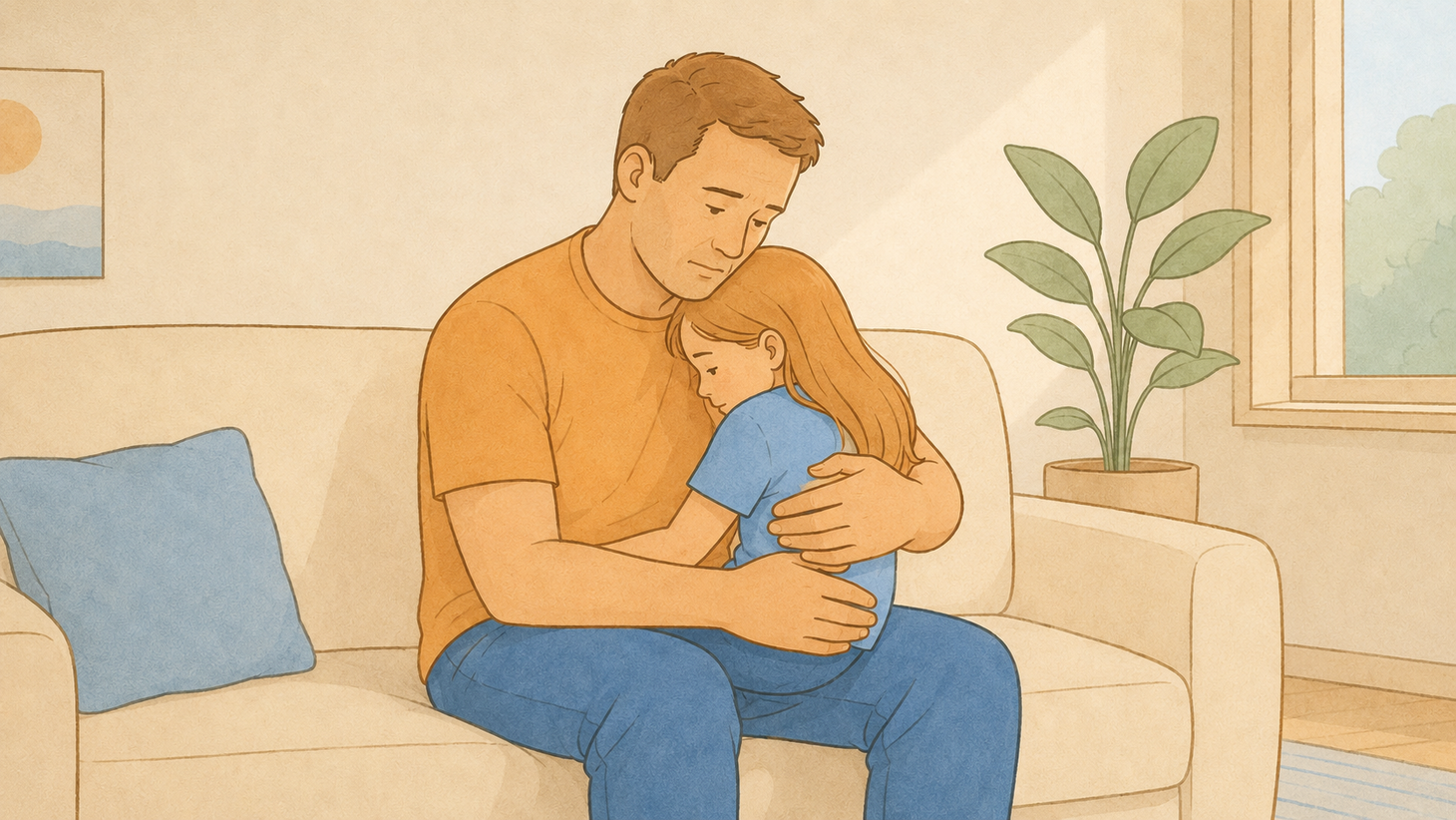
As we were finishing breakfast and getting ready to get out the door for school, my daughter began to cry and tell me that she missed our family being together.
I know in those moments that my work is to sit with her. To avoid running to easy answers. To make sure I’m validating her feelings and her experience.
As I sat with her, I could feel the self-judgment and anxiety in my own chest. I could feel the urge to encourage her to move through the feelings more quickly so that we could both feel better.
But really so I could feel better.
And so we sat together, mostly in silence.
She didn’t want to be held. Her lip quivered. Tears rolled down her cheeks.
Between long moments of silence, I assured her that I loved her and was with her. That her family was with her. That we all love her. That it’s okay that some moments are very hard.
As only children seem able to do, she fully felt the feeling and moved through it. Five minutes later she was dancing around cheerfully and climbing into the bike to head to school.
But I found myself hanging on to the dark, swirling emotions the moment had brought up for me.
I biked her to school, hugged her goodbye, and dropped her off. On the ride home, I got a text from my usual 9 a.m. client that he had woken up sick and needed to postpone our session.
I found myself grateful.
I knew I needed to do some work myself.
I’m deeply grateful for what I learned during my time at the Hoffman Institute because it gave me a unique set of tools for mornings like this.
I came home and, on a large poster-board-sized sticky note, sketched the face of what Hoffman calls my dark side. The part of each of us that whispers the nastiest things to us in our heads. That tells us we’re fakes or failures, stupid or fat or not enough. Whatever it can find to keep us down and quiet and alone.
Then I wrote down every message I heard from him that morning.
You ruined your family.
You’re a fake.
You’re a shit coach.
You’ve broken your daughter’s heart by ending your relationship with her mother.
You’re fat and not athletic.
No matter what you do in life, you’re going to end up alone.
Then I brought the poster out to my office in the back house and set it on the ottoman.
I put Limp Bizkit on the Sonos.
I took out a wiffle bat that I keep for just such an occasion.
And I beat the shit out of that poster board.
As I did, I said out loud everything I had to say to my dark side and those messages.
I’m a good man.
I deeply love my children.
I’m doing my very best to make choices aligned with my values, choices that support my well-being and the well-being of the little ones I love.
It’s not my job to earn the approval of anyone but me.
I’m a good father.
I’m a good coach.
I’m a good man.
That dark side, and everyone whose voice is joined in it, can fuck right off.
I have work to do. Love to give. A life to live.
I smashed the paper, gathered it up, and smashed it again. Over and over until sweat was pouring down my face and I felt sure the message had been given and received.
Then I gathered the scraps and tore them into smaller pieces as I dropped them into the wastepaper basket. As I did, I said out loud what I knew to be true about me, my life, my parenting, and my work.
And then I plopped down on the sofa and put on a self-compassion visualization.
Self-compassion, I have come to learn, is one of the most powerful and underrated tools we have for caring for ourselves. Bringing compassion to the parts of us that are hurting. Bringing compassion to our inner children, those tender, sensitive young parts of us that still carry old wounds.
I found myself thinking about a few lines from Rumi that had inspired me earlier today:
“Keep looking at the bandaged place. That’s where the light enters you.”
For 20 minutes, I allowed myself to do just that. To drop back into that moment at the breakfast table. Into the pain it had brought up for me. The tightness in my throat. The ache in my chest. The churning in my stomach.
As I moved through the visualization, I was brought back to myself as a child, about the same age as my daughter. Maybe five years old. Sitting in the grass in the backyard of my family’s home.
And in the visualization, I sat with that child.
This was the most tender moment for me.
I realized that there is a part of me, a younger and more sensitive part, that, like my daughter, is hurting and angry about the decision I have made.
The adult, grounded part of me knows it was a decision I needed to make for my own well-being and growth. In some ways, even for the well-being of this younger, tender part of me.
But that doesn’t mean he isn’t grieving.
That young part of me is, at moments, full of grief and anger over the loss of this family structure. And the feeling is so familiar because that same child experienced the turmoil in my family of origin and, eventually, the breaking apart of that family too.
Sitting with my daughter’s grief had touched my own.
And I think that’s part of the work.
Because the more I can tend to my own grief and anger, the less I need my daughter to move through hers quickly so that I can feel okay.
I can simply be with her.
I can give her what I know she needs most in those moments: the calm presence of her father.
The work of our own healing is perhaps some of the most difficult and important work of our lives.
I don’t often write about my own healing in real time. But today I decided to, in case sharing mine might make you feel a little less alone in yours.
Whatever questions or pain or grief you’re looking at today, there are people who will sit with you as you look at yours, while continuing to look at their own.
I’ve been blessed by the people who have looked at my hard questions and my pain alongside me, and who have shared theirs so that I feel less alone in this strange experience of being human.
You are not alone.
We’re in this together.
Wishing you healing and safety,
Matt
P.S. Today's post is dedicated to my writing coach Rachel Jepsen, who lovingly asked me what it might look like for me to write 'full punk rock'. And to Elizabeth Gilbert, who modeled this courage for all of us in All The Way To The River.
I appreciate that you are here. If you’d like to get these posts in your inbox, you can subscribe here.
Looking for some support? If now is the time to consider coaching, reach out here.

Sanity Notes Newsletter
Join the newsletter to receive semi-weekly updates in your inbox.